Custom Patches: MOQ, Pricing & Bulk Discounts
The minimum order quantity (MOQ) for custom velcro patches starts at 10 units in the UK. This page explains how custom patch pricing works, what drives the cost per patch, and how bulk discounts lower your unit price as quantity rises. Custom patches are priced on a tiered model, so larger orders reduce the price per patch through fixed price breaks. Every quote includes free digitising and Pantone colour matching, with VAT applied at the standard UK rate of 20%.
What Is the Minimum Order Quantity (MOQ) for Custom Patches?
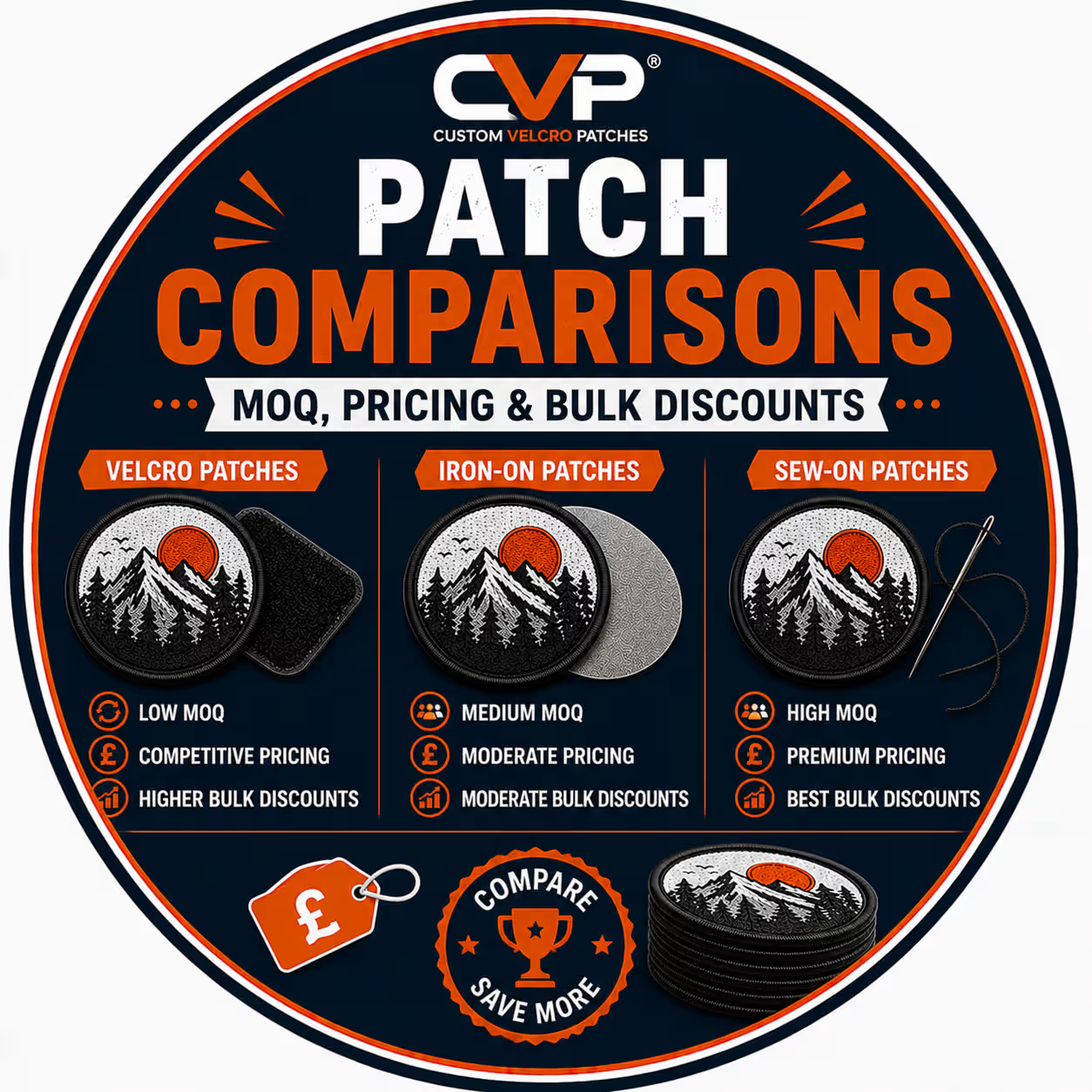
The minimum order quantity is the smallest number of patches a manufacturer accepts for a single custom run. Custom velcro patches have an MOQ of 10 units, which suits small clubs, single-team orders, and event runs. The MOQ exists because every custom patch order requires one-off setup: the artwork is digitised into a stitch file, the thread colours are matched to your design, and the production line is configured for your specification. These setup tasks cost the same whether you order 10 patches or 500, so a minimum order keeps the per-unit price viable.
A low MOQ benefits small businesses and organisations directly. Schools, scout groups, sports clubs, and start-ups order in modest volumes, and a 25-unit minimum lets them test a bespoke design without committing to hundreds of units upfront. Larger suppliers often set their MOQ at 50 or 100 pieces, which prices smaller buyers out. Custom Velcro Patches keeps the minimum accessible so that a cadet detachment ordering name tapes pays a fair rate, and a corporate team ordering branded morale patches reaches a bulk discount tier sooner.
Why Custom Patches Have a Minimum Order
Fixed Setup and Variable Costs
Custom patches carry a minimum order because production combines fixed setup costs with variable per-unit costs. The fixed costs cover embroidery digitising, thread colour matching, and machine configuration, and these are incurred once per design. The variable costs cover twill backing, thread, hook-and-loop fastening, and labour, and these scale with quantity. A minimum order spreads the fixed setup cost across enough units to keep each patch affordable.
Protecting Production Efficiency
The MOQ also protects production efficiency. Embroidery machines run most efficiently in batches, so a manufacturer producing 25 identical patches in one pass achieves a lower unit cost than producing them individually. This efficiency is passed back to the customer as a lower price. The minimum order, therefore, is not a restriction designed to inflate spend — it is the threshold at which custom production becomes cost-effective for both the supplier and the buyer.
MOQ by Patch Type (Embroidered, Woven, PVC, Printed)
The minimum order quantity varies by patch type because each type uses a different production process. Embroidered patches and woven patches share the lowest MOQ, while PVC patches and printed patches sometimes carry a higher minimum due to mould creation and print setup. The table below shows the indicative MOQ for each patch type.
| Patch Type | Minimum Order Quantity 10 | Production Note |
|---|---|---|
| Embroidered Patches | 10 units | Standard twill base, merrow border, digitised stitch file |
| Woven Patches | 10 units | Fine thread weave, ideal for small detailed logos |
| PVC / Rubber Patches | 10 units | Requires a one-off mould, raising the minimum |
| Printed Patches | 10 units | Full-colour print setup applies |
| Chenille Patches | 10 units | Raised yarn texture, popular for varsity and clubs |
Embroidered patches deliver the best balance of low MOQ and durable finish, which is why they remain the most ordered type for UK uniforms and workwear. Woven patches suit logos with fine text or intricate detail, because the tighter weave reproduces small features that embroidery thread cannot. PVC patches require a custom mould, so their minimum order sits higher to recover the tooling cost. Each patch type, therefore, sets its MOQ according to the setup its process demands.
The patch type you choose also affects your unit price, not just your minimum order. The next section explains how custom patch pricing is calculated and which specification choices raise or lower the cost per patch.
How Custom Patch Pricing Works
Custom patch pricing combines a one-off setup cost with a per-unit price that falls as quantity rises. The setup cost covers digitising your artwork into a stitch file and matching your thread colours, and you pay it once per design. The per-unit price covers the materials and labour for each patch, and it drops at fixed quantity tiers called price breaks. Your final cost, therefore, depends on three inputs: the patch specification, the order quantity, and the patch type.
Most UK suppliers quote a “from” price per patch and confirm the exact figure once they see your artwork. Custom Velcro Patches calculates each quote against your design, your chosen size, and your backing, so the price reflects your specification rather than a generic rate. This approach gives you an accurate cost before you commit, and it lets you adjust the specification to fit your budget.
One-Off Setup & Digitising Costs
Digitising is the process of converting your artwork into an embroidery stitch file that the machine reads. The digitiser maps every line, fill, and colour change in your logo to a stitch path, and the resulting file controls thread direction, density, and sequence. Custom Velcro Patches includes digitising free with every order, so there is no separate setup fee on your quote. Competitors frequently charge a setup or digitising fee on the first order, then waive it on repeats, which raises the cost of small bespoke runs.
Free Digitising Service
A free digitising service lowers the entry cost for first-time buyers. The stitch file is also stored after production, so a repeat order uses the same file at no extra charge. This means your second order of the same patch starts at a lower total cost than your first, because the setup work is already complete. The digitising stage, therefore, is a one-time investment that benefits every future reorder.
VAT and What’s Included in the Price
Custom patch prices in the UK are subject to VAT at the standard rate of 20%. Custom Velcro Patches displays prices excluding VAT and adds the 20% at checkout, which is standard practice for UK business suppliers. Your quote, therefore, shows the net price per patch, and the VAT is calculated on the total order value.
The quoted price per patch is inclusive of the core production elements: the twill base, the embroidery thread, the merrow border, the hook-and-loop backing, and free digitising. Delivery within the UK is charged separately or included above a set order value, and express turnaround carries an additional fee. Knowing what the price includes lets you compare quotes accurately, because a low headline rate that excludes digitising or backing is not a true like-for-like comparison.
Factors That Affect the Price Per Patch
The price per patch depends on the specification you choose, and several factors raise or lower the unit cost. Each factor changes either the material used or the production time, and both feed into the final price. The list below shows the main cost drivers for a custom velcro patch.
- Patch size — larger patches use more twill, thread, and hook-and-loop backing, so the unit price rises with surface area measured in millimetres.
- Patch type — woven patches carry the lowest unit cost, while PVC, chenille, and leather patches cost more due to moulding, yarn, or premium material.
- Stitch count / thread coverage — a densely embroidered design uses more thread and machine time than an open design, which increases the price.
- Number of colours — additional thread colours add machine thread changes, and complex Pantone matching raises the cost slightly.
- Border and edge finish — a standard merrow border is economical, while a custom laser-cut or die-cut edge costs more for the precision finish.
- Backing type — hook-and-loop (velcro) backing costs more than a plain or sew-on backing because it adds two fastening layers.
Patch size and stitch count are the two largest cost drivers, because together they determine how much thread and machine time each patch consumes. A small 50 mm logo patch with an open design costs far less per unit than a large 150 mm back patch with dense fill stitching. You can reduce your unit price by simplifying the design, lowering the colour count, or choosing a smaller size, and our team advises on these adjustments during the quote stage. The specification you choose, therefore, gives you direct control over the cost per patch.
Bulk Discounts & Price Breaks Explained
Bulk discounts reduce the cost per patch as your order quantity rises, and they apply automatically through fixed price breaks. A price break is a quantity threshold at which the unit price drops to a lower rate. Custom Velcro Patches sets price breaks at 10, 25, 50, 100, 250, and 500+ units, so an order of 100 patches pays a lower rate per patch than an order of 50. The discount needs no code — the lower rate applies as soon as your quantity reaches the next tier.
How Price Breaks Reduce Your Cost Per Patch
Price breaks work because the fixed setup cost spreads across more units as the quantity grows. The digitising, colour matching, and machine configuration are paid once, so doubling the order quantity halves the share of setup cost carried by each patch. The variable material cost stays roughly constant per unit, while the fixed cost per unit shrinks. The result is a falling unit price at every tier, with the largest saving on the move from a small run to a mid-volume order.
The Steepest Discount
The steepest discount occurs between the lowest and middle tiers. An order moving from 25 to 100 patches sees the biggest drop in cost per patch, because the setup cost is spread across four times as many units. Beyond 500 units the unit price continues to fall, but the rate of decrease slows, since the setup cost is already thinly spread. Ordering in bulk, therefore, delivers the best value when you consolidate demand into a single larger run rather than several small repeat orders.
Example Price Break Table (Quantity → Unit Price)
The table below shows an indicative price break structure for a standard embroidered velcro patch. The figures are placeholders modelled on UK market rates and illustrate how the unit price falls at each tier.
| Quantity | Indicative Unit Price | Saving vs MOQ |
|---|---|---|
| 25 (MOQ) | £4.50 | — |
| 50 | £3.20 | 29% |
| 100 | £2.40 | 47% |
| 250 | £1.85 | 59% |
| 500+ | £1.40 | 69% |
The unit price drops by almost half between the 25-unit minimum and a 100-unit order, which demonstrates why even a modest increase in quantity improves value. A buyer ordering 250 patches pays roughly 60% less per patch than a buyer ordering the minimum. To compare how this affects total value across patch types, see our guide on the cost and value of custom patches, which explains where each type delivers the best return.
Bulk Orders for Schools, Clubs & Businesses

Schools, Clubs & Businesses
Bulk patch orders suit organisations that equip groups in matching uniform or kit. Schools order woven name badges and house patches, scout groups order activity badges, and sports clubs order embroidered crests for kit and jackets. These organisations reach the higher price break tiers easily, because they equip every member, and the lower unit price keeps the per-person cost down. Corporate teams order branded morale patches and workwear badges, and recurring orders qualify for repeat-order pricing on the stored stitch file.
Large or Recurring Bulk Orders
Large or recurring bulk orders qualify for a tailored quote beyond the standard tiers. Orders above 500 units receive custom pricing, because the volume supports a lower rate than the published price breaks. To start a large order, request a free custom patch quote and our team confirms your tier-based rate against your artwork and specification.
MOQ & Pricing by Patch Type
The minimum order and starting unit price differ by patch type, because each type uses a distinct material and process. The comparison table below summarises the MOQ and indicative entry price for each custom patch type, helping you select the type that fits your budget and design.
| Patch Type | MOQ | Indicative Starting Price | Best For |
|---|---|---|---|
| Woven Patches | 25 | £1.20 | Fine detail, small logos, lowest unit cost |
| Embroidered Patches | 25 | £1.40 | Uniforms, jackets, durable everyday use |
| Chenille Patches | 25 | £2.10 | Varsity, sports clubs, raised texture |
| Printed Patches | 50 | £1.60 | Full-colour, photographic detail |
| PVC / Rubber Patches | 50 | £2.30 | Outdoor, tactical, waterproof finish |
| Leather Patches | 50 | £2.80 | Premium branding, bags, workwear |
Woven patches offer the lowest unit cost, which makes them the most economical choice for detailed logos at volume — explore the full specification on our woven patches page. Embroidered patches cost slightly more but deliver the most durable, textured finish for everyday wear. PVC and leather patches sit at the premium end, because moulding and genuine material raise the production cost. The patch type you select, therefore, sets both your minimum order and your starting unit price.
How to Get an Accurate Patch Quote
Getting an accurate quote takes five steps, and each step refines the price against your specification. Follow the sequence below to receive a firm cost per patch and total order value.
Submit your artwork
Upload your logo, design, or sketch in any common format, and our team assesses it for digitising.
Confirm your specification
Choose your patch type, size in millimetres, border, and hook-and-loop backing, because these set the unit price.
Receive your digitised proof
We digitise the artwork free and send a digital proof showing the stitched design for your approval.
Select your quantity
Pick a quantity at or above the MOQ, and the matching price break sets your cost per patch.
Approve and order
Confirm the digital proof and quantity, and production begins with UK delivery in 10–14 days.
Selecting your size affects the unit price directly, so review our patch sizing guide before confirming your specification. If you want to check quality before committing to a bulk run, order a single sample first and approve the finish before scaling up. Following these steps, therefore, gives you a firm price and a verified design before production starts.
Our Customer Reviews
Frequently Asked Questions
Is there a minimum order for custom velcro patches?
Do you offer bulk discounts on custom patches?
Is the digitising or setup fee charged separately?
Does the price per patch change by patch type?
Are custom patch prices subject to VAT?
Summary
Custom velcro patches use a tiered pricing model that rewards larger orders with a lower cost per patch. A low minimum order of 10 units keeps bespoke patches accessible to small clubs and businesses, while fixed price breaks reward organisations that order in volume. Your unit price reflects the patch type, size, stitch count, and backing you choose, and free digitising removes the usual first-order setup fee. Consolidating demand into a single larger run secures the best value, because the fixed setup cost spreads across more patches. When your specification is ready, request a free quote and our UK team confirms your tier-based rate against your artwork.
Request a Free Quote